Inflation Protection and Taxes

Tax PaperIt’s important to understand that inflation protection is removed when taxes are applied.  Current tax rules disregard inflation, and as a result it’s easy to demonstrate that inflation can cause all of our interest on a TIPS and some of our principle to be lost through taxation alone.

When we consider our inflation adjusted returns, we can easily see that the real tax rate climbs to astronomical levels.  This simple example shows how easy it is for taxes to use up all of our real returns.

A Revealing Example

Let’s consider the effects of taxes on our inflation adjusted gains.  These adjusted gains are what finance professionals call our “real” gains.

Let’s use the actual TIPS that is being offered as I write this and our current inflation rate.  Our current inflation rate is actually 2.2% but we will use 2% make it easier and more conservative.  If you buy a $1000, Ten year TIPS with a 0.5% interest rate and experience inflation that averages about 2% during that time, the overall real gain would be 5% over 10 years and the overall inflation adjustment if it stayed the same during that period would be 20%.

After 10 years, your principle would be adjusted to $1,200 and you would have been paid about $60 in interest.  The problem is that you are not taxed on the just the $60.  The tax rules require that you be taxed on the $60 real gain + the $200 of principle adjustment.  If you are paying taxes at a low 15% rate, the rules say that you must pay 15% of $260 or $39.  Since you really only earned $60 in real value, you will have paid 65% in taxes.

That’s a very high tax rate for sure, but look what would happen if we had an unusual amount of inflation.  This is something we need to consider because our intention is to protect ourselves from both average and unusual changes in inflation.

Let’s change the average inflation to 5%.  After 10 years, your adjusted principle would now be $1500 and your 0.5% interest would be $75.  Your tax on $575 at 15% would now be $86.25.  Since you only really earned $75, taxes will have taken all of your real gain and forced you to take a loss of $11.25 on top of that.  That comes out to be a real interest rate of -0.1125% and a real tax rate of 115%.

In a taxable account, the greater the inflation, the less the protection.  I can’t honestly say that it provides any protection at all because a taxable account amplifies inflation.  It is wrong to assume that our savings is inflation protected just because we hold a TIPS.

One Safe Place

If you open a tax advantaged account such as a 401k or an IRA at a brokerage that allows you to hold TIPS within it, your savings is guaranteed to be protected.  That’s because all growth in a tax advantaged account is either not taxable or tax deferred.  This means that all inflation adjustments to your TIPS principle will only be taxed once, either before you put it into a Roth IRA or 401k or after you take it out of a traditional IRA or 401k.

The combination of a tax advantaged account and TIPS is currently the only option that I am aware of that will guarantee inflation protection to a person attempting to save money in United States.

I Bonds are Only Guaranteed in Certain Cases

I Bonds are tax advantaged in that they are exempt from state and local taxes.  That makes them an even better option than other “safe” investments.  This still does not protect them from a total loss of real gains through federal taxation on inflationary gains.  There is one more advantage though.  If an I Bond is used for tuition, it is tax free and becomes a great way to save for a child’s education.

It is also possible to sell your I bonds at a time in which your taxable income is below your exemption allowance.  If your total income falls below the your permitted exemption, then your I Bonds are tax free for that year.

A Problem for All Investments

It’s very important for all investors to understand that this problem exists outside of TIPS and I Bonds.  As far as I know, all investments have the potential of losing all of their real gains through taxes that are amplified by inflation.  Here’s an explanation of the effects on capital gains:

It’s not just a problem for investors, though.   Inflationary gains are taxed in your very own bank account.  Your interest may be only $1 per year, and you may have actually lost $5 of purchasing power in your account.  You would think that would mean that you lost $4 in purchasing power.  Since you pay taxes on your inflationary gain of $1, it pushes the loss even lower than $4.  Inflation amplifies your taxation because the more inflation there is, the more tax you pay.

Important Things to Remember about Tax Advantaged Accounts

If you have the ability to have 401k, I highly suggest that you do that.  IRAs only allow you to contribute $6,000 per year for those under the age of 50 and $7,000 per year for those over 50.  401k’s allow you to hold far more depending on your income.

If you are a high-income individual.  You currently have no guaranteed protection from inflation for savings that I know of.  It may be a good idea to consider moving your investments overseas.  There are several nations that don’t have capital gains taxes including Mexico and New Zealand.

Building Your Own TIPS Annuity

Building a CubeI got an interest payment from one of my TIPS recently.  It feels pretty good to watch your income automatically go up with inflation.  As I mentioned in the article: “Introducing Treasury Inflation Protected Securities (TIPS)“, these bonds pay out interest on your inflation adjusted principle.  The percentage of interest stays the same, but the bond amount itself goes up as it is adjusted for inflation.  That means that your income goes up too.
What I feel when I get my inflation adjusted income, may be a result of the fact that I’m so used to being charged an inflation premium.  All I’m really experiencing is consistency.  I’m just getting the same purchasing power from my money as I had when I purchased my bond.  As I considered the fact that loaning out money is capable of producing an ongoing, inflation protected income, I realized that this could be used to create a reliable income and preserve the principal at the same time.

Considering the Possibilities

I don’t talk very much about the income from TIPS because I primarily focus on their ability to protect our savings, but if you have enough money and don’t want to risk it somewhere else, you could use TIPS as a way of getting inflation adjusted income for the rest of your life while also protecting your principal.

You’re intention would be to preserve the principal for the rest of your life.  Perhaps you already have a large sum that is intended for your heirs or for charitable giving in your will.  You could be using that money to generate an income while keeping the principle safe and adjusted for inflation.

Even if you don’t really need the income, you could generate it and give it away while you are still alive.

Making Your Own Annuity

There’s really nothing new to creating your own “annuity” with TIPS.  It’s just a frame of mind.  The only difference is that you are using TIPS for the purpose of generating income.  If you do plan to use them in this way, you might consider getting the 30 year TIPS.  Not only will the income stay consistent for 30 years, you usually get the highest amount of income from the longer term bonds.

Keeping it Real

You might be wondering why you wouldn’t just use CD’s for this purpose.  Remember, that the interest rate for TIPS is a “real” interest rate.  That means that inflation has already been calculated into the TIPS interest.  You have to subtract the inflation rate from your CD’s current interest rate and then compare it to the TIPS rate.

If, for instance, the interest rate on your CD is 2.04%, and inflation is currently at 1.90%, your real interest rate for the CD is only  .14%.  If you compare that to a 1% interest rate on a TIPS, you would see that you would earn .86% more “real interest.”  That’s a whopping 614% more income on the same principal.

Fee Considerations

There really aren’t any fees when you buy a TIPS, but I like to consider any bond premiums and taxes as fees when you make an annuity out of them.

A premium is when you pay more than the face value for the bond.  This happens when you buy a TIPS at auction and the price for the TIPS goes above the TIPS amount itself.  It can also happen when you buy a TIPS from someone else on the market.  For instance, you may end up buying a $1000 TIPS for $1100 at auction.  If you do, you are paying a premium of $100 to get a $1000 TIPS.  That $100 is like a fee because you had to pay it up front just to get the bond.  It could take a while to recover that fee, but if you are doing it to protect a future income stream from inflation, it may not matter much to you.  You are paying for a guarantee, just like you would with insurance.  As long as you are still working, you can pay that fee with current income.  This is a way of protecting future income while you have current income.

Taxes are a similar kind of thing.  With TIPS, taxes are like an annual fee.  You could think of it as a fee to the government for using their system to protect your money.  The fee is paid at your tax rate.  The bad thing about this fee is that it goes up with inflation.  That makes this fee pretty expensive in a high inflation environment.

These fees may still be acceptable to you for protecting your income stream.  With a commercial annuity, you may end up in the same place when you calculate in the loss of principal to your heirs.

If you were to put this annuity in an IRA or 401k, you would completely remove the tax “fee” and if you were careful to only buy your TIPS at a discount instead of a premium, you would also not have to pay the premium “fee.”

You’re the Boss

The thing that makes this so much better than a commercial annuity, is that you have complete control over the principal.  The terms are very clear and your investment is backed by the full credit of the United States.  All of the money is still under your control.

If you are wondering why you’ve never heard of this before, it might be because there is no money in this kind of annuity for anyone else but you.  When you build your own TIPS annuity, you get to decide what to do with the principal and your heirs get it all back in the end without any exposure to the markets.


How to Buy an I Bond

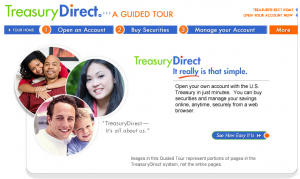
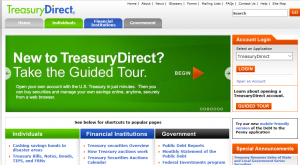
Picture of the front page of the Treasury Direct website

If you looking to buy an I Bond, but you’re not sure where you need to go or what you need to do, you’ve come to the right place.  Just follow these simple step-by-step instructions.  They will help you set up your TreasuryDirect.gov account and buy your first I Bond.  If you have a printer, you may want to print these instructions so that you don’t have to go back and forth between these instructions and TreasuryDirect.

This could take 15 – 30 minutes.  It’s good to take your time.  There’s no reason to hurry.  I suggest doing this on a computer, not a cell phone because you may be asked to allow your computer to use “Flash.” One of the demos provided at TresuryDirect uses Flash and should work fine on IE, Edge, Firefox and Chrome  browsers.

If you are wondering why you would want to buy an I bond, please read the articles: “I Just Want to Save My Money!” and “Why Bonds are Smart for Savings“.

Step 1: Gather Your Info

You need to be a “U. S. Person” and have a Social Security Number in order to buy U. S. savings bonds.  It’s one of the special privileges you have just for being a United States citizen.

You will need an address in the United States if you want to participate in buying I Bonds directly from the government, so have that ready too.

You will need to have a checking or savings account so that you have a way to pay for your I Bond.  You can’t pay with a credit card but it’s ok if you don’t have paper checks.  You just need to call your credit union or bank and get your checking account’s routing number and account number so you can pay Treasury Direct with electronic checks.

Like most online services these days, you will need to provide Treasury Direct with a valid email address.  They intend to contact you electronically with information about your account.

You have to have a computer with a browser that can create a private line to Treasury Direct.  Pretty much all computers for the last ten years have been able to do this.  The computer you are using to read this should work as long as it is a private one.  It’s probably not a good idea to do your finances on a public computer.

Step 2: Take the Guided Tour at TreasuryDirect.gov
Picture of the TreasuryDirect Guided Tour page

Although this government site has its own oddities, they’ve done a great job of holding your hand through the process of setting up your account.  You and anyone in your household that has a Social Security Number is entitled to have a free account directly with the United States Treasury.  They have a pretty nice “Guided Tour” that shows you the steps that you will go through when you set up your account.  Here it is:

TreasuryDirect.gov’s Guided Tour

If you need to type the address in, here it is:

https://www.treasurydirect.gov/indiv/TDTour/default.htm

Step 3: Complete the Application Process at TreasuryDirect.gov

The application process will allow you to set up your TreasuryDirect.gov account by entering the information that you have collected.

From the Guided Tour page, you can find the application link in the upper-right corner of the page.  It’s called “OPEN YOUR ACCOUNT NOW“.  At the time that I write this, the letters are pretty small but they are all orange.

f you are on the Treasury Direct starting page, you will find the place to open the account underneath the orange login button.  Just click on the words: “Open an Account

Make sure that you record:

  1. Your new account number
  2. Your new password
  3. The answers to your security questions (they will ask them sometimes and it will lock you out if you don’t answer them correctly)

It’s a good idea not to save these things on any computer or cell phone.  You might consider writing these down and saving them with other vital records and information you keep.   Physically locking the information in a safe would be one good idea.

Step 4: Watch the Accessing Your TreasuryDirect Account Demo
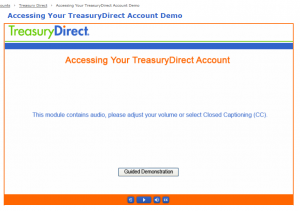
Accessing Your TreasuryDirect Account Demo Page

The TreasuryDirect site has quite a few security features.  It’s a good thing but it also makes it a bit harder to use.  I highly suggest that you watch the Flash Demo that they have created at the TreasuryDirect.gov site.  You can click on the graphic on the right or  click here.  Make sure that you say “yes” if your browser asks if you want to us “Flash”.

Here’s the address if you need to type it in:

https://www.treasurydirect.gov/indiv/myaccount/myaccount_demo.htm

Step 5: Sign In to TreasuryDirect

To log in, locate the “Account Login” section in the upper right corner of the TreasuryDirect.gov website.

Select the “TreasuryDirect” link in that section. On the next page, select the orange “LOGIN” button.

If this is the first time that you have logged in, you may be asked to check your email for a special passcode.  This is a security protection to make sure that it is really you.  You must enter that code that you get from your email.  You can choose the option to allow TresuryDirect to remember your browser.  That way you won’t have to get special codes in your email every time you attempt to log in.

On the next screen you must enter your new Account Number.  That’s not the passcode.  That’s the one that you used when you first applied in step two above.  After typing in your account number, hit the “submit” button.

You will then be taken to a screen that allows you to choose an image and a phrase.   This might seem a bit silly, but it is actually a good security method.  TreasuryDirect will show you this picture and phrase every time you log in.  It’s a way for you to know you are actually accessing TreasuryDirect and not a fake.

If that image is ever not the one you remember. It’s a good idea to close your browser and contact TreasuryDirect by phone and tell them that something is wrong before going on.  All these things are there to make sure that you are protected and that’s a good thing.

Below that you will see a graphical keyboard.  Instead of typing your password using your keyboard, you need to type your password using the graphical keyboard, with your mouse.

After you hit the “submit” button, the weirdness is pretty much over.  You will now be signed into TreasuryDirect.  You should see a welcome message with your name at the top of the screen.

One other strange thing to keep in mind about the TreasuryDirect website: Don’t try to use your “back” button in the browser.  That will force you out, requiring you to log in.  TreasuryDirect will only allow you to use the buttons on the page to navigate.  All these things help the web site give you a very secure environment.

I did find some graphical instructions at WikiHow that may also be very helpful.

Step 6: Buy Your I Bond

Now for the fun part.  We are finally to the point at which you can buy your first I Bond.

Now that you have logged into your account, you will need to click on the button at the top called: Buy Direct

You will then see a list of options of things you can buy.  In the list you will see an option for “Series I – An accrual-type security with a combination interest rate of a fixed and an inflation rate”

Select that option and Hit the blue Submit button.

You will a place to enter your “Purchase Amount“.  Enter the bond amount here.  You can have a bond as low as $25 and if this is the only bond you plan on buying this year, you should be able to have one for as high as $10,000.  I haven’t tried that before but it should work as long as you have the money.  Make sure that the “Select a source of funds” drop-down box shows your checking account and then hit the “Submit” button.

That’s it.  When you log back into TreasuryDirect, you will be able to check up on your I Bond and see its current value.  This is also the place to go when you are ready to sell your bond.  You can’t do that for the first year, because that’s one of the rules.  It’s best to hold on to your bond for five years so that you get all the interest.

You can also buy other kinds of treasury investments this way including TIPS.  That’s all it takes to take advantage of one of the safest and most effective ways to save for your future.

How Inflation Protected Mutual Funds Fail to Protect (Part Two)

Binoculars on a ledge in the sunIn part one of this series, I explained that, although mutual funds make good investments, they actually introduce new risks to a saver because they  expose shareholders to market forces.  I brought up the problem that happens in the bond market when interest rates seem too low for a bond.  In this article, I expand on interest rate risk.  I explain that a bond holder can choose to ignore it, but a mutual fund shareholder has no choice but to be exposed to it.

Interest Rate Risk: A Risk for Investors

There are two reasons why a bond’s interest rate might seem low in the future to investors in the bond market. One reason would be that the Federal Reserve has decided to raise interest rates significantly during the bond’s life. A five percent bond might have seemed like a great investment 10 years ago, but if your checking account is now paying five percent, it’s a sign that times have really changed. All bonds, including inflation protected bonds, are subject to this kind of “interest rate risk.” It’s not really a risk, though. It’s missing out on a better opportunity. Your money is still all there and it will all be returned to you at the bond’s maturity. You will have received all the promised interest at that time. The only difference is that you could have possibly invested in a different way and done better during that same period of time. Notice that this is an investment problem, not a savings issue. If you were trying to protect your savings, then a bond would still have been effective at insuring your money. That’s why I believe that interest rate risk is a risk to opportunity investors, not to savers.

Inflation Risk: A Problem for Everyone

The second reason why a bond’s interest rate might seem low to investors in the future, is if our money experiences a loss in purchasing power. If minimum wage goes up to $50 an hour, a $1000 bond isn’t going to seem as valuable to us when it matures as it did when minimum wage was $10 per hour. That’s why we protect our savings from inflation. Typical bonds cannot protect us against this. In fact, they are highly exposed to it. That’s why we want to use inflation protected bonds for our long term savings instead of typical bonds. With all of this as background, let’s consider a very strange marketplace. Let’s consider the inflation protected bond market.

The Inflation Protected Bond Market

As I mentioned before, because mutual fund managers trade bonds before they mature, bond mutual funds are exposed to the bond market. This same thing is true for mutual funds that hold inflation protected bonds inside of them, so let’s consider what causes the market price of an inflation-protected bond to change.

It turns out that one of the worst things you can do to an inflation protected bond is to expose it to the market. Trying to predict the future value of an inflation protected bond is complicated and the market prices change in complex ways. Inflation protected bonds are affected by the possibility of a rise in interest rates, just like other bonds, but they tend to be a place of safety for people seeking to protect themselves from the possibility of inflation. If it is perceived that inflation is going up more than interest rates, then prices may go up in this market. If interest rates go up while inflation drops, it could mean that prices drop considerably.

Another thing that can cause prices to drop is when there are a lot of people leaving the bond market which causes the value of existing bonds to drop. It is not unusual for bonds to be priced lower than it cost to buy them, even when they have a large inflation adjustment.

A True Story

At the time that I write this, inflation protected bond funds have not fully recovered from a drop that the market experienced in 2013.  What this means is that if you were to have purchased shares in an inflation protected bond fund in 2013, you would have failed to keep up with inflation.  This is a clear demonstration of the risk that you take when you put your savings into an inflation protected bond fund.  This is proof that it may not keep up with inflation for certain time periods.  The market probably will recover at some point in time.  The only problem is that we don’t know when that is. That’s what I call timing risk and that’s not a part of my savings protection strategy.

Protection from the Market

By simply choosing to buy your own bonds and hold them until maturity, you escape the wild prices changes in the bond market. With a “buy and hold” strategy, you can avoid the fear that comes from watching market prices suddenly drop. When you hold your bonds until they mature, you will always receive the amount you expect to receive, adjusted for inflation.

Focusing on the Right Thing

If you have a 401k or an investment account at a brokerage, you probably have noticed that their tracking software focuses on market prices. When you are a buy and hold savings investor, this can be very distracting and misleading. In order to focus on the right things, you must train yourself to not pay attention to market prices since they don’t mean anything to you. We shouldn’t be too excited when market prices are up and we should not be worried when they are down.

That’s one of the reasons that I decided to make software that tracks the real value of our long-term savings. By focusing on the maturity value and not the current price, it puts our minds at ease, knowing that we are still on the right track.

How Inflation Protected Mutual Funds Fail to Protect (Part One)

Egg Balanced on ForksInflation protected bonds are a great way to protect your long-term savings and it’s easy assume that inflation protected mutual funds or ETFs are just as good, but that’s actually not the case.   There’s increased risk to savers who hold bonds in a mutual fund.  In this two part series, I explain some of the risks and why I don’t recommend using funds for this purpose.

The Benefits of Mutual Funds

Mutual funds are pretty convenient to an investor.  They are relatively easy to buy and sell and are managed by professionals.  They allow us to leave our investments in highly qualified hands.

Mutual funds are also very well advertised.  You can find out a lot about them because they are in almost everyone’s 401k. Mutual funds can be a win-win situation for the novice investor and the experienced money manager.  The problem with mutual funds and ETF’s is that they are inherently more risky than bonds because they have added exposure to market forces.

Preservation vs. Opportunity Investments

When we are saving, we intend to preserve our money for a specific point in time.  Mutual funds help us take advantage of investment opportunities, but they don’t commit to pay at a point in time.  We are able to pick a good management team and pay them to pick the best time to buy and sell stocks and bonds, but they don’t promise that our money will be there when we need it.

As I mentioned in the article: “Stressed about Savings? Divide and Conquer!”  it’s very helpful to divide your money into two separate parts before you start.  Mutual funds can be a valuable part of the opportunity side of your investing, but too risky for the preservation side.

The Safety of Bonds

Bonds have traditionally been a much better place to store money for long term savings.  That’s because bonds are loans with a due date.  When a bond matures, you get all your money back.  I discuss this at length in the article: “Why Bonds are Smart for Savings

The danger bonds have is the possibility that your money won’t be paid back to you at all.  We do have to consider who we are loaning our money to.  Risky bonds are not good investments for savings either.  You can diversify them, but they are still not good preservation tools because you may not get all your money back when you need it.  Good quality bonds, however, can be seen as a good method of saving for the long term as long as they are adjusted for inflation. That’s because you have a reasonable commitment that you will be paid on time.  Mutual funds, on the other hand, don’t come with a commitment to pay anything.

Bond Funds

As safe as bonds are, you would think that putting bonds into a mutual fund or an ETF would produce the best of both worlds, but that’s not the case.  A surprisingly risky set of things happen when you put bonds into a fund.

When you invest in a bond fund, you are not owed anything anymore!  When you own a bond directly, the bond issuers legally owe you money on a specific date.  In a mutual fund, the bond issuers owe the fund money, but they don’t owe you anything directly.  This is very important to understand.  If you intend to insure your savings, then it’s better to choose a method of savings that provides you a direct guarantee.

You might be wondering why a bond fund would not be able to pass along the bond issuer’s guarantee.  There are some valid reasons.

Funds are Mutual, Bonds are Not

It’s important to understand that a bond fund is owned by a group of people.  This creates a problem for savers.  In order for a bond to preserve your money, you must hold that bond until it matures.  There is no money available until a bond matures, unless you are willing to sell the bond at the current market rate.  Funds, on the other hand, allow shareholders the ability to buy and sell at any time.  If all of the other shareholders had the same intentions as you, it might work well to use a bond mutual fund, but that isn’t the case at all.  There are some shareholders that may actually sell their shares before the bonds in the fund mature.  If enough people do that at the same time, it could force the managers to sell some of the bonds at a rate that is lower than what was paid for them.  As you patiently hold your shares, the value in the fund would go down because of what others decide to do.

Bond Market Exposure

What this tells us is that by putting a bond into a fund, it exposes the fund to the bond market which can be as unreliable as the stock market.  If the bonds are always held to maturity, they have no exposure to the bond market and there is nothing to worry about.  I have found that bond funds usually follow bond market prices, not bond maturity values.

Let’s consider some of the risks the bond market exposes an investor to.  Remember that the bond market is just a place to buy and sell loans that haven’t been paid back yet.  The market is subject to what buyers and sellers perceive about the future.  Since these loans are dependent on an interest rate,  investors are exposed to the potential that the bond’s interest rate will seem small in the future compared to newer bonds and other investments that become available.  Since investors want to hold loans with the largest payout, the loans with the lower interest rates would lose market value.  They could even lose enough value that they temporarily fall below the original principal.  If a fund manager is forced to sell at that point to pay a mutual fund shareholder, it deeply hurts the fund.  Since you own a share of that fund, it hurts you too.  When you buy a bond directly, you can hold the bond and ignore the market.

Click here to go on to part two

Why Bonds are Smart for Savings

Colorful Eggs in Small Colorful BucketsBonds are one of the easiest and most common ways to save money for the long term.  There’s a good chance you already own one.  If you have a certificate of deposit at your bank or your credit union, you own a kind of a bond.  CD’s are quite a bit different than other kinds of bonds, but they have many things in common.

Rather than going over different kinds of bonds, I’d like to explain why  they are a good investment for those of us saving for future needs.  In a previous article, I described two ways of looking at our investments.  Bonds are very useful for the part of our savings that we intend to preserve.

Bonds Eliminate Timing Risk

I mentioned back in my introduction to TIPS that bonds are actually a  type of loan.  CD’s are loans that you make to the bank.  If you ever wondered how to turn the tables on a bank and get them to pay you interest, that’s how.  If you have had a CD before, you know that it has an end date.  That’s how bonds work.  They “mature.”  When they do, you get your money back.

Because bonds have a due date, they are great for eliminating timing risk.  Bonds come with a promise to return your money on a specific day.  If you intend to go on a big vacation in two years, you can get a two year CD at the bank and earn higher interest than you would in a regular savings or checking account.  When the CD matures, you get your money back and all the interest right when you need it.

You can imagine what might happen if you put that money in a mutual fund for two years.  If you happen to have planned your vacation during the next stock market crash, you probably would have to change your plans.  It might be ok to miss your vacation, but putting off your retirement because you took that risk would probably be a bigger deal.

Certificates of Deposit and Inflation

Taking out a two year CD might not be that bad.  At the time I write this, CD rates are still quite a bit lower than the rate of inflation.  When that is true, you end up paying the bank to hold and protect your money.  That’s not always a bad idea.  Putting all that money in your house might be worse, but it sure would be nice to be able to keep up with inflation don’t you think?

I Bonds vs. CD’s

You might consider I Bonds for a two year holding time or more.  You can’t take your money out for the first year, so if you need the money sooner than that, it wouldn’t be a good idea.  If you need the money in less than five years, it would still be a pretty good idea to put your money in an I Bond because it protects your purchasing power at the cost of losing three months of interest.  It’s still better than most bank CDs at the time that I write this.  After five years of waiting, you can take the money out any time.  If you have more than 30 years to wait, you will have to sell your bond in thirty years and get a new one.  You can find out more about I Bonds in another article.

The advantage of using an I Bond over a CD is that you are more certain to keep up with inflation.  There are CD’s that allow you to “step up” your interest rate if the interest rates go up at some point.  The problem with that is that interest rates and inflation are not really linked.  The will of the government is in between.   Governments occasionally force interest rates lower as a way to “fix” the economy.  As a result, CD’s have proven to not be a very precise way to protect your money’s purchasing power.

Using a Bond Ladder

Ladder with fruitYou may have seen an article or heard someone at your bank talk about putting some money in a CD ladder.  This arrangement helps you take advantage of changes in interest rates over time.  It’s another way to attempt to deal with inflation issues as well.

The idea is that you split up your money, and buy CD’s or bonds with different maturity dates.  For instance you might buy one for six months, another for one year and another for two years.  The idea being that every six months you would have a CD coming due.  When it does, it allows you choose whether you need to use some of the money or put it back into another CD.  It also allows you to take advantage of changes in the interest rates as they go up.

When you are trying to save your money for later, bond ladders have much different purpose.  When you are using inflation protected bonds like I Bonds or TIPS you don’t really have to worry about the interest rates.  Remember that taking advantage of rising interest rates is the kind of thing we do with the part of our money set aside for opportunity investing.  When we are dealing with the preservation side, what we concern ourselves with is timing.  We just need to ask ourselves: When do I need this money?  In this case, we would use a ladder to put the right amount of money in the right place in the future to meet our needs.

Here’s an example.  Suppose you need your money in 15 years.  It may require that you take out a ten year TIPS, and after 10 years you need to remember to buy another 5 year TIPS when it matures.  You can think of your needs like buckets of money.  Let’s say that you have one bucket for each year during your retirement.  You need a ladder of bonds that reach to each bucket in order to fill them with the right amount of money so that you meet all of your needs.

Beware of Bond Mutual Funds

Bond mutual funds don’t have a maturity date.  Shorter duration funds may be safer than stock funds, but they are definitely more risky than just owning the bonds.  That’s because the fund share prices change every day based on market forces, not inflation.  I plan to explain that more in an article about mutual funds.

A Smart Way to Plan

Bonds are a great way to plan because they are based on time commitments.  Not everything in life can be planned, but for things that need to be, it really makes sense to use investments that have commitments built into them so that you can be sure to have money when you need it.

Stressed about Savings? Divide and Conquer!

Piggy Banks

JamesCube (Pixabay)

Trying to decide what to do with the money you have can be stressful.  There are plenty of people willing to “help” you invest your money, but they rarely agree on how.  Just leaving it the bank doesn’t seem right, but neither does losing it all in the market.  I have found that dividing my money into two parts reduces the stress and gives me confidence.

Protection vs. Opportunity

There are two very different points-of-view when it comes to investing money.  It’s possible to look at money as something to protect for some point in the future.  It is also possible to look at it as an opportunity for gain.  Both perspectives have benefits, but they require that we invest in different ways.

When we look at money from a protection point of view, we want to make sure that we don’t lose it.  Our concern is not about future gains, but about having something at a specific time.

When we look at money from an opportunity point of view, we are willing to wait in order to get a big gain.  We’re hoping to use money in order to get significantly more, but we can’t really control the timing of it.

These two points of view, are at odds with one another.  Like the old saying goes, you can’t have your cake and eat it too.  We can’t protect something and risk it at the same time.  When we choose opportunity, we also choose to risk not having our money at a specific point in time.

Many of the professionals in the financial world are more focused on opportunity than they are on protection.  It’s good to keep that in mind when you seek help.  If your intention is to protect, you probably won’t need professional help.  With a little education, you should do just fine on your own.

Insurance vs. Investments

Those who intend to preserve their money are better off thinking about it like they would insurance.  That’s because when you preserve, you are saving what you’ve already earned.   You’re just making sure that it’s there for you when you need it.  A preservation mentality is helpful when you are saving for specific things.  Those things might include maintaining or buying a car.  Other things include buying a house, paying for college or for paying for retirement.  Preservation is good for those things that you already know that you will probably need.

When you want to use your money to take advantage of growth opportunities, insurance doesn’t really make sense.  That’s because you’ve accepted the risk that your money won’t necessarily be there at a specific point in time.

Promise vs. Potential

When we make a decision about where we put our money, we need to decide whether we care more about having a promise that our money will be available, or that we have the potential to gain when opportunity arises.

These kinds of financial arrangements are at odds with each other but they both have their place.  If there was no potential for gain, there wouldn’t be a way to have something to preserve.  If there was no place to save your money, how could you keep what you have gained for a time that you need it?

Determine Your Timing Related Risk Capacity

When I say “timing related risk,” I mean the kind of risk you expose yourself to by not having money when you need to use it.  Considering your timing related risk capacity is a good way to decide whether you should preserve or speculate.

source: nattanan23 (Pixabay)

If you don’t have any savings at all, then you are at risk whenever something doesn’t go right.  You really don’t have any capacity for timing risk.  If you have no extra money and your car’s transmission fails, you would immediately be in financial trouble.  It’s important to have emergency savings and not having it definitely qualifies a timing related risk.

There are other timing related risks you may have.  Retirement is an important one.  You can calculate the amount of time that remains before you plan to retire and the amount of money you might need for the rest of your life from that point.  These projections expose a risk.  If your retirement money isn’t there when you need it, you will probably suffer.  Other things have timing related risk too, like buying a house, paying for college or paying for family vacations.

When we think about risk, we need to consider what we would feel like if our money wasn’t there when we need it.  If the money you are thinking about isn’t going to be needed for a particular time in the future, then opportunity investing is probably a good idea for you.  If you know what the money is intended for, then preservation investing would probably be a better idea.

A Helpful Separation

I have found it helpful to separate my money into two distinct parts.  One is the part I intend to preserve as savings.  That part includes my emergency savings, the part of my retirement savings that would pay for my basic retirement needs and any other amount of money that I would rather preserve than take risks with.  These may include funds I intend to use as an inheritance or a donation.

The other part is for investments that I believe will eventually be profitable.  For these investments, I accept that I don’t know when they will be profitable and I am willing wait.

Less Stress

By taking your savings and setting it aside as something you intend to preserve, you don’t have to worry about how much money it makes.  As long as it keeps up with inflation, it will still be there for you.  The rest you can use to do some investing.  That’s the part you may want to have an investment professional help you with.  If things don’t go quite as well you expected them to go, you can rest assured that your savings is still intact.

Thinking of Retirement as Standard of Living Insurance

Professor Zvi Bodie of Boston University said something that really shaped my thinking about retirement savings.  He said that we should think about retirement savings more like we think about insurance.  When I tried that, I realized that it caused me to challenge the advice about retirement that I often hear and read about.  It exposed something that I was seeing that I knew didn’t seem right as I was planning for retirement.

Assurances are not Guarantees

Fund managers want you to invest in their products, but they don’t give guarantees.  They are careful to have disclaimers so that we understand that we could actually lose our money.  That’s worth taking time to consider.  Professor Bodie says that these management companies are in a far better position to understand risk management than the common person, yet they refuse to guarantee that you will even have your retirement savings when you need it.  They give assurances, but they refuse to give a guarantee.  Professor Bodie says that the reason they don’t give a guarantee, is that they can’t.  Instead, they leave the risk of the investment with the person who is least knowledgeable about what they are doing.

A good thing to ask ourselves is: “Why can’t they give a guarantee when they are managing the money?”  The answer is: “Because the investments they use are risky and they know it.”

Professor Zvi Bodie does a great job of explaining the problem here in his video:

Is it really Savings?

I think that there is terminology that retirement fund salespeople should not be using.  They often refer to the money that we put into mutual funds or the stock market and other volatile investments, as our “retirement savings.” In my opinion, the money we are putting into those kinds of investments are actually “retirement ventures.”  Since no one is committed to maintaining a specific amount of money in those accounts, I don’t think that it can legitimately be called: “savings.”

When we use the word “savings” we naturally think of money in a piggy bank or money in a banking institution.  In those places, our money is insured in some way.  Our piggy bank is locked in our house and our bank accounts even have deposit insurance from the federal government.  We naturally expect that when we return to our bank, we will find the same amount or more than we left in it, but that’s not how most “retirement savings” accounts work in my experience.

Unfortunately, we need to be on guard when money managers use the term: “savings.”

Guaranteeing our Savings

There are ways to guarantee savings, and some of them come at a cost.  We know that insurance has a cost because many of us have insurance for other things like healthcare,  our cars or a house.  Insurance costs something because someone else is bearing a risk for us.  When we think of something as important as our retirement, doesn’t it make sense to insure that it will meet our basic needs?  Sure there are things in retirement, like golf or fancy vacations, that we don’t really need.  I’m not talking about that necessarily, but what about food and medical needs?  What about the power bill or visiting family for Christmas?  Do we want to become a burden on our adult children when it can be avoided?

Zvi Bodie brings up an interesting point in another place.  He suggests that we consider the fact that we are willing to pay $1000 for fire insurance for our house even though it is very unlikely that our house will burn down.  The chances are very small, yet we still pay for it.   That’s because we believe that the seriousness of not having a house outweighs the fact that it is unlikely to happen.  What good a house if I am unable to live in it in because my retirement savings has disappeared?  It doesn’t really make sense to protect the house and not protect my income.

Two Categories of Retirement Funds

Thinking about retirement in this way leads to dividing our retirement funds into two parts.  One part is the part you reasonably believe you can’t do without in your old age.  The other part is for things that you hope for, but that are not critical to your survival.  When we divide it up like this, and get insurance for the critical part, it can lead to peace of mind knowing that our critical retirement needs are guaranteed to be there for us.

Guaranteed Retirement Options

When it comes to ways to guarantee the critical part of your retirement, you might be imagining a large piggy bank or perhaps a bank CD.  If you have been reading my blog, however, you know what I think about that.  Both piggy banks and CD’s are not usually inflation protected, which means that they are not a guarantee.  They fail to be a guarantee because you don’t know what the contents of your piggy bank will buy in 30 years when you need it.

There have been CD’s that were “inflation-linked” in the past but I have not seen any in the last few years.  Hopefully, demand for them will increase and they will be offered again in the future.

Social Security

One obvious form of retirement insurance is Social Security.  It is inflation protected and it’s definitely something to consider when thinking about your critical retirement savings.  Social Security is likely to go through some changes in the future, but I expect that something very similar to it will be available for a long time to come.  There’s more about this investment in the article: Possibly the Most Popular Inflation Protected Investment.

Company or Government Pensions

If you happen to have a job that offers a pension that adjusts your payments for inflation, you are in a good position.  When I say pension, I mean the old fashioned kind that doesn’t require that you manage the money and that does provide a written guarantee.  Pensions that don’t adjust for inflation, are helpful but they don’t guarantee that you won’t run out of money to pay your expenses in the distant future.

Be Careful With Insurance Annuities

Other insurance products are provided by insurance companies by way of inflation adjusted annuities.  I would just make sure that the inflation adjustments are connected to actual inflation and not a flat percentage increase each year.  It’s important to understand how much you are paying for that insurance up front too.  Beware: Insurance companies use the word “guarantee” in a similar way that fund managers use the word “savings.”  Make sure you know what they are actually guaranteeing.  Guaranteed percentages are not the whole story.  You also need to know the exact amount of principal the percentage is calculated against.  If the principle goes down with something other than inflation, it’s not much of a guarantee.  Also remember that if the guarantee isn’t in writing, it’s still not a guarantee.  Insurance companies do and have gone out of business.  Zvi Bodie recommends splitting up your funds between companies.

Home Equity

The Equity in our homes really is a form of inflation protection.  Because a house is a physical thing that represents one of our important needs, it’s automatically inflation protected.  Its value goes up with inflation because a house is still a house no matter what the value of money is.  Just having your home paid off is big part of insuring your retirement.

This presents an option for those who have no heirs or have no other choice.  Many of us spend our lives paying the bank to own a house.  The tables can be turned.  It is possible to sell the equity to the bank and have them pay you to live in your own house.  That’s what is called a reverse mortgage.

Once again caution is needed.  Make sure to read everything in any contract to make sure that the bank isn’t taking too much for themselves in the deal.  They may woo you with assurances that the remaining equity will go to your heirs, but I am told that this is often not the case because of high fees.  Again, there’s no guarantee.

Another thing to consider is selling your house to your heirs, with permission to continue living in the house as long as you can.  Working a deal with your loved ones could be a practical option and it can be a win-win situation with them.

Inflation Protected Bonds

My favorite option is to use Treasury Inflation Protected Securities and I Bonds for savings that I want to insure.  I do have to do a bit more work myself, but fees are low or non existent.  These are just boring government bonds that usually don’t make a whole lot of interest, but they do one thing very well: they protect long-term savings from inflation and that’s what I’m looking for when it comes to protecting the critical part of my retirement savings.

Further Reading

How to Buy an I Bond
If you are ready to get some I Bonds right now and protect some of your savings, I’ve made some step-by-step instructions to help you set up your Treasury Direct account and purchase your first I bond.

The Effects of Inflation

Hamburger with fire background

Meditations (Pixabay)

Whether intended or not, one of the bad effects of a government-regulated monetary system, is that it creates a disconnect between money and the real things we need to buy.  Take food for instance. If we were use hamburger gift certificates instead of the money we use today, we would know that we would get the same amount of food for our money today as we would after leaving the certificates in a box for 10 years.  Somehow, we’ve managed to mess up our monetary system such that it is significantly more difficult to depend on it for real needs… like eating or clothing ourselves.

Let’s consider the effects of inflation using terms that we can actually eat.  Let’s assume that you had put a 10 hamburger certificate under your mattress in the year 2000, only let’s also assume that someone has allowed inflation to eat your hamburgers without your permission over time.  How many hamburgers do you think you would be able to buy today with an inflation adjusted 10 hamburger certificate?  By 2017, your 10 hamburger certificate would only buy you about 5.68 hamburgers.  This is quite typical, inflation is usually eating away at our savings.  There’s a website that makes it easy for you to see how the costs of things have changed over time as a result of inflation.  It provides a calculator that allows you to enter your own dates and amounts and see the effect for yourself using the government inflation data.

Try it at:  US Inflation Calculator

The problem is that once money is disconnected from something real, it can change in value quietly over time.  For much of the United States’ history, our money has been buying less and less over time.  There were periods in which inflation went backwards.  Yes, that’s called deflation.  That might sound good at first, but those times are often harmful as well.  One of the most notable times that this happened in our history was the Great Depression.  If deflation is happening to money, it’s likely that it’s because people don’t have jobs or money to pay for things they need.

Whether our problem is inflation or deflation, disconnecting money from something that is real is not a very good savings plan.  In order to plan, you kind of need to know how many hamburgers you will get to eat, shoes you will get to buy or tanks of gas you will be able to fill.  Thankfully, there are still some tools at our disposal that can help us combat the effects of inflation like I Bonds and TIPS.  They’re not quite as easy as putting money under your mattress, but at least they are available.

A “Neutral” Government?

If philosophical neutrality is a fallacy, as I previously asserted, then building a government on this philosophy is a critically serious problem.  It appears to be a trend in governments across the world and it looks like a plan forged by the powers of darkness to me.

Peace does not come by the careful application of a fallacy.  It only comes through love and proper reasoning and that will mean that those who are thinking irrationally will have to be exposed.  That exposure doesn’t feel very good and some will fight to death over it, but I know from experience that true humility brings peace when we are finally willing to admit that we are wrong.

I was reading a report from a few years ago, about a Canadian ruling that was addressing the contents of prayers before meetings.  I am told that they were warning that there are prayers that may not be legal.  This appears to be a clear case of philosophical absolutism to me.  The United States has it share of the same kind of thing, as do other countries.

We may be tempted to assert that a government should stay out of speech related issues, but in reality, how can they?  A government must assert a philosophy of some kind or else it cannot function.  It has no choice.  The problem with what governments are doing is that the philosophy they are asserting is often irrational.  You can’t rationally assert a philosophy that assumes that no philosophy should be asserted. A government built on a foundation of irrationality is in no position to bring about peace or anything else.

With great sorrow, I see the problem again in the recent speeches of both President Trump and Vice-President Pence.  Their words sound like an attempt to respect all religions and creeds, even though it is obvious that they can’t.  In many of the same speeches, they rightly express that that there are certain creeds and religions that they do not respect, such as those that kill people or promote the destruction of the United States or disrespect its constitution.  Are these not creeds and religions?  This is confusing to say the least.  That’s not what made America great.

If they intend to go back to America’s foundation, they must return to the doctrine of Christian tolerance which asserts that although Christians don’t respect other creeds and religions, they do tolerate them to a degree in civil life, because that’s what Jesus expects us to do until He chooses to deal with them Himself.  Christian tolerance is built on the concepts of free will, grace (meaning favoring others when they don’t really deserve it), and the fact that Jesus is still alive and able to take care of the wicked without our help.  Christians desire that all men will come to know Jesus by willingly accepting His offer.  This means that, according to Christian tolerance, there can be no force when it comes to individual choice either.  This is the basis for American liberty and it also happens to be non-neutral.

So why is this a big deal?  It’s because it’s this issue that leads a people toward either liberty or tyranny.  If a government doesn’t have the authority over life, liberty and personal property, it definitely doesn’t have authority over the Creator that endowed those rights.  Any government that thinks it does that is indicating that it believes it is the supreme authority in certain matters.  Even if taking God’s place isn’t intentional, that’s what is being communicated and it leaves the door open to serious future problems.  Even now we are seeing the desire for philosophical respect drive the followers of various ideas to converge against Christianity, asking that it either comply or be silenced by “civil” government.  Since Christian tolerance is the basis for our liberty,  freedom as we know it is in serious danger.  What governments must do is to acknowledge that their right to rule comes from the God of the Bible, the true One that the Christians have acknowledged.

Other brands of neutral thinking have already been used in the west and have failed quite miserably at critical times.  Recall that Neville Chamberlain attempted to bring peace in his time using a method that would allow the UK to respect Hitler’s choices.  President FDR signed a peace agreement with Japan in a similar gesture right before we entered the war.  It’s important for us to remember how well those things worked out.  How about those Israeli peace agreements?

It’s important to ask ourselves: What good is peace if freedom is taken away?    There is a way for peace and freedom to coexist, but it depends on Christian philosophy, because that’s the only way they fit together without the government becoming an irrational tyrant.